
Nicholson Collection
The Nicholson Collection contains nearly 30,000 artefacts representing ancient cultures from the Mediterranean, North Africa, Middle East and Europe. Spanning from the pre-Neolithic to the late medieval period, these artefacts hold intimate stories of people’s everyday lives, ancient environments, and cultural activity for over more than 10,000 years
The collection was founded in 1860 by Sir Charles Nicholson (University Provost 1854–62) with a donation of Etruscan, Greek, Roman and Egyptian antiquities acquired to establish a museum, "calculated materially to promote the object[ives] for which the [The University of Sydney] was founded." (Nicholson's letter of presentation, 1860). By 1870 the University of Sydney's Museum of Antiquities included over 3,000 artefacts and had been nicknamed the Nicholsonian Museum.
Over the past 160 years the Nicholson Collection has expanded through ambitious acquisition programs, generous donation and private bequests. International excavations in Egypt, Cyprus and the Middle East, partly sponsored by the University of Sydney have also contributed significant objects to the collection. The history of each collection area is outlined in the sections below.
Today, the Nicholson Collection constitutes the most extensive collection of antiquities in the southern hemisphere and is a valuable resource for teaching, research and public display of ancient history. The collection is partially accessible online via our collections search, with more artefacts added each month thanks to the behind-the-scenes work of our volunteers and collections management team. The Nicholson Collection is open to researchers, including students, interested in studying the past through material culture. To apply to research with the collections please get in touch with our curatorial team.
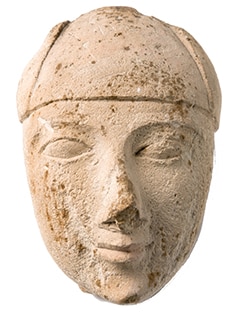 Head of a male figurine, 600–550 BC
The Nicholson’s collection of Cypriot antiquities spans the Neolithic to Medieval periods and includes a significant holding of Bronze Age artefacts from funerary contexts. A range of artefact types from ceramics to sculptures, bronze tools and glass work represent the diversity of ancient Cypriot artistic expression and cultural connections.
Beginning in 1860 with a single artefact from the original donation by Sir Charles Nicholson, the Cypriot collection grew exponentially under the curatorial direction of William J Woodhouse (honorary curator 1903-37) and James Stewart (curator 1957-62). Many of the artefacts were acquired directly from excavations directed by Stewart conducted across the island, both before and after he joined the University of Sydney as Lecturer in Archaeology. The collection includes representative archaeological material from the sites of Bellapais Vounous, Karmi Palealona, Karmi Lapasta, Nicosia Ayia Paraskevi and Vasilia Kafkallia. Excavation archival materials related to the excavations at Karmi are cared for as part of the Nicholson Collection’s (informal) archives.
Excavations directed by Basil Hennessy, Professor of Near Eastern Archaeology (1970-1990) at Myrtou Stephania, Kafkala and Shagion, led to the addition of significant tomb groups, including human remains, to the collection. Further sites represented in the collection include Dhenia, Pano Dhikomo Mavro Nero, Aphendrika, Tsambres (Vryso), and Kouklia Asproyi. These materials were acquired through ongoing relationships with the Department of Antiquities, Cyprus, rescue excavations, loans with Cambridge University and the personal collection of James Stewart.
The University of Sydney continues to excavate under auspices of the Department of Antiquities of the Republic of Cyprus at Fabrika Hill, Kato Paphos. All finds from modern excavations remain in Cyprus and are cared for and exhibited by the Archaeological Museum of the Pafos District.
The Nicholson Collection also holds approximately 50 artefacts related to the infamous Cesnola brothers, active in Cyprus in the late 19th century. These were acquired by the Nicholson through purchases from the Metropolitan Museum of Art and exchanges or loans with Stanford and Cambridge Universities in the early 20th century.
The Cypriot collection has been further developed with private donations, benefactions and purchases including the acquisition of two oversized bichrome amphorae. The first was donated in 1937 by Eleanor Woodhouse, widow of the former curator William J Woodhouse and the second was purchased in 1946 with funds raised by the Friends of the Nicholson Museum to form a paired set (NM46.36, NM47.21).
Key publications:
- Barker, C. (2012). Aphrodites Island: Australian Archaeologists in Cyprus. Nicholson Museum, The University of Sydney.
- Barker, C. & R.S. Merrillees. (2017). 'Cypriot antiquities from the Cesnola collections in the Nicholson Museum at the University of Sydney' Mediterranean Archaeology, 30, 51–72.
- Webb. J. (1986). Cypriote antiquities in the Nicholson Museum at the University of Sydney. Corpus of Cypriote Antiquities Vol 20. P. Åström.
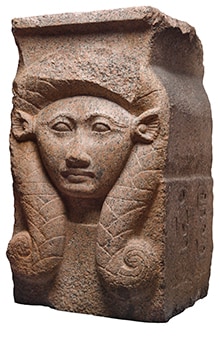 Hathor depicted on red granite column capital from the Temple of Bubastis, c.900 BC
The Egyptian collection is expansive in its representation of artefact types dating from the Neolithic and Pre-dynastic periods through the Pharaonic ages to Roman and Coptic late antiquity. Included in the collection are the mummified bodies of four individuals, three with coffins, named Meruah, Padiashakhet, Mer-Neith-it-es and Horus, as well as further mummified partial remains of individuals who cannot be identified.
The nucleus of the Egyptian collection was formed in 1856–57 when Sir Charles Nicholson travelled down the Nile acquiring artefacts of artistic and archaeological importance related to the ancient centres of Memphis, Saqqara, and Thebes, primarily from antiquity dealers active in Alexandria, Cairo and Luxor. His aims to procure a teaching collection ensured the objects he collected encapsulated a wide range of periods and material types. His acquisitions were first transported to England where they were catalogued, and published, by Joseph Bonomi and colleagues at the British Museum, before being sent to Australia for the establishment of the Museum in 1860. In 1862, a second journey through Egypt afforded Nicholson the opportunity to embellish his original donation, securing significant statues and inscriptions for the museum, including a bust of Horemheb depicted as a royal scribe, before he became king (NMR.1138).
In 1888 the University of Sydney, with the assistance of prominent businessman Josiah Mullens, established a formal sponsorship with the Egypt Exploration Fund (later Society, EES). In return for their financial contributions, the University was sent crates of artefacts from recent excavation seasons, beginning with the 3.6 tonne Hathor column capital from the Temple of Bastet, Bubastis. Between 1888 and 1963 the museum acquired nearly 1000 artefacts through its sponsorship of the EES from excavation sites including Abydos, Antinoë, Behnesa, Bubastis, Diospolis Parva, Tell el-Amarna, El Mahasna, Naukratis, Oxyrhynchus, Qasr Ibrim, Tanis and Tell el-Yahudiya.
The Nicholson Collection of Egyptian artefacts has been greatly strengthened by the generous donations of private persons throughout its history. Donors include tourists and migrants, who before modern plane travel frequently visited Egypt as part of the journey between Australia and Europe, as well as Australian Defence Force Personnel, who were stationed or embarked/disembarked in Egypt during World War One and Two. While it was common in the early 20th century to purchase ancient artefacts, Egyptian and international law today strictly prohibits the illicit sale of antiquities and cultural heritage.
Key publications:
- Sowada, K. & B. Ockinga (eds). (2006). Egyptian Art in the Nicholson Museum. Sydney: Meditarch. Buy online
- Fraser, J, Lord, C. & J. John Magnussen (eds). (2022). Speak My Name, Investigating Egyptian Mummies. Sydney: Sydney University Press. Buy online
- Richards, C. (2021) Egypt in Australia. University of Western Australia. PDF avaliable online.
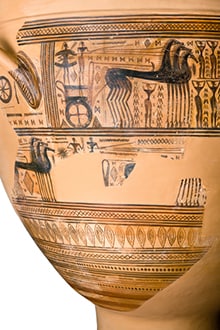 Detail of the 'Dipylon Krater' circa 750BC.
The Greek collections contain artefacts representative of the material culture of the Greek mainland, islands and surrounding regions, from the Bronze Age to the late Hellenistic period. A wide range of Archaic-classical period ceramic vessels are the cornerstone of this collection. However, bronze and terracotta figurines, marble sculpture, intricate jewellery and plaster cast replica objects contribute contribute to the diversity of the collection.
During Sir Charles Nicholson's travels to Egypt and Europe in 1856–58, he acquired, approximately 70 Classical and Hellenistic ceramic vessels and figurines. These were predominately acquired in Rome and South Italy and are demonstrative of the ancient cultural appetites of the Italian peninsula for imported Greek vessels.
Arthur Dale Trendall (honorary curator 1939-1958) established a proactive acquisition program to develop the under-served areas of the Nicholson Collection, including Hellenic material culture. Trendall was active in purchasing Greek antiquities on the international art market, and sought donations from prominent museums and scholars, including Sir John Beazley. Trendall’s Handbook to the Nicholson Museum (2nd edition published 1948) highlights the success of this program detailing the chronological development of Greek ceramic tradition illustrated by important new acquisitions such as a fragmentary Dipylon Vase (NM46.41), oversized white ground lekythoi (NM41.1), and a Rhodian aryballos in the shape of a warrior’s head (NM47.1).
The collection was further expanded following a donation of hundreds of pottery fragments and votive objects by the family of Trendall’s predecessor William J Woodhouse (honorary curator 1903-37) in 1948. These artefacts were collected by Woodhouse from key archaeological sites, particularly in the Peloponnese, between 1890 and 1935. His research trips are documented in the Woodhouse photographic archive, donated to the Museum by his daughter Liska Woodhouse in 1986. These photographs capture the sites, monuments and village life of the Greek mainland during this period and are a rich historical record of landscapes and monuments of early modern Greece.
The Greek collection also includes a series of plaster cast and electrotype replicas of large free-standing sculptures, architectural relief sculptures, votive offerings and impressions of Minoan and Mycenaean seals and rings. This collection was formed in the early 20th century when casts were essential for teaching art history and classical archaeology. While many of the large sculpture casts were donated to Sydney schools in the 1960s during a redevelopment of the Nicholson Museum, roughly 80 sculptures were retained and are cared for as part of the collections.
Key publications:
- Richards, C. (2023). 'Unexpected legacies: The collections of classicist William J. Woodhouse (1866–1937), then and now’ Journal of the History of Collections.
- Richards, C. (2021). 'Beyond the Curator: Understanding the women who helped shape the Nicholson collection' Classicum 47.2.
- Cambitoglou, A. & E.D.G. Robinson (eds). (1995). Classical Art in the Nicholson Museum. Meditarch
- Trendall, A.D. (1948). Handbook to the Nicholson Museum, 2nd edition. Australasian Medical Publishing.
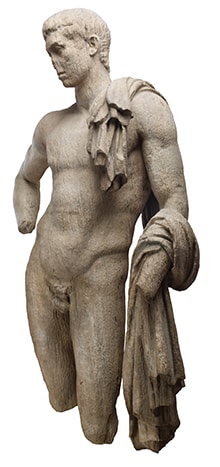 Marble sculpture of Hermes, first century BC
The Italian collection represents the diversity of the ancient Italian peninsula during the first millennium BC with significant cultural material from Etruria and South Italy. The collection is further enriched by Roman period artefacts from across the Empire including Northern Europe, North Africa, Anatolia, Cyprus, the Middle East and from Rome itself, spanning the early imperial to Byzantine periods.
This area of the collection began with Sir Charles Nicholson’s 1857-58 visit to Italy, where he amassed approximately 500 artefacts including Etruscan funerary urns, ceramics and bronzes, South Italian ceramics and Roman period funerary epitaphs, life-sized sculpture, a sarcophagus and sarcophagi fragments, ceramics, and every day use items such as bronze vessels, tools and figurines. As with Nicholson’s purchases in Egypt, his intention to create a teaching collection led to a wide variety of representative material relating to ancient Italian history. In 1935 Nicholson’s three sons donated a life-sized first century BC sculpture of the god Hermes, from Smyrna, Turkey, that had been given to their father by Sir George Macleay in 1881.
During the curatorial tenures of Arthur Dale Trendall (1939-58) and Alexander Cambitoglou, (1963-1999) the Nicholson Collection became well known for its collection of South Italian ceramics. Trendall and Cambitoglou were leaders in the field and published widely on the identification of painters and significance of scenes depicted on South Italian ceramics. Both curators actively pursued the art market to acquire a considerable range of vessel and thematic types for the collection. The corpus of the South Italian red-figure vases was published in the first two Australian volumes of the Corpus Vasorum Antiquorum series, in 2008 and 2012.
The Nicholson maintains a diverse collection of ancient Roman material culture across the principal geographic collecting areas. This includes several hundred sherds of Roman red slip primarily from the ancient Gaul and Britain centres of production, the Deissmann collection of Roman Egyptian Ostraka (donated by Robert W Gillespie in 1936), 16 fragments of wall paintings collected from Pompeii during World War Two, and household and funerary artefacts from sponsored excavations at Hu (Diospolis Parva), Egypt, Jericho, and Pella in Jordan. Most recently the Nicholson Collection acquired a panel of a North-African household mosaic featuring two wrestlers (NM2018.135). This panel was given to the Astronaut Richard Gordan by the King Hussen II of Morrocco in 1970 in recognition of Gordan’s role in the successful Apollo 12 mission and purchased for the collection with funds from the Joyce Marchant bequest in 2018.
Key publications:
- Cambitoglou A. & E.D.G. Robinson (eds). (1995). Classical Art in the Nicholson Museum. Meditarch.
- Cambitoglou, A. and M. Turner. (2008). Corpus Vasorum Antiquorum. The Nicholson Museum, The University of Sydney. The Red Figure Pottery of Apulia. Fasc 1., (2012). The Red Figure and Overpainted Pottery of South Italy. Fasc 2. Sydney University Press
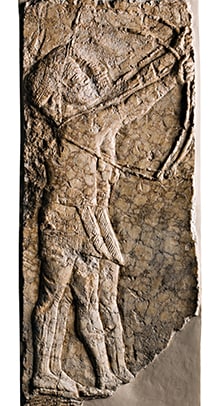 Assyrian archers carved on limestone from Ninevah, 700-680BC
The Middle East collection is representative of the great urban centres that flourished along the Levantine coast, across Mesopotamia and along the Indus Valley. Artefacts acquired from key excavations of the 20th century form the core of this collection and additional ceramic sherds offer insight into the development of ancient Anatolia. Overall, the collection spans from the pre-Neolithic period through the significant developments of the Chalcolithic and Bronze Ages up until the Roman era.
The Middle Eastern collection began in 1926 with the donation of just four objects from the Sumerian city of Ur, by the British Museum. This was followed nearly 10 years later with another donation, this time of 296 items, from the 1922-34 excavation seasons. Throughout the 1940s and 50s Arthur Dale Trendall (honorary curator 1939-58) and James Stewart (curator 1957-62) actively sought to develop the Middle Eastern holdings of the Museum. This included purchasing specific collections as well as exchanging Indigenous Australian cultural material and other items, from the wider University of Sydney departmental collections, for Middle Eastern artefacts.
Their approach was incredibly successful with sherd collections and representative materials useful for teaching received from Government organisations such as the Iraq Museum, Israel’s Department of Antiquities, the Government of Turkey and the Government of India as well as from international museum collections including the Oriental Institute of Chicago, Ashmolean Museum, Institute of Archaeology London and National Museum of Copenhagen.
Significant sites and cultural groups represented in the collection include:
- Harappa, in modern day Pakistan
- Tell el-Ajjul, Gaza
- Tell Atchana, Turkey
- Tell Lakhish, Israel
- Tell Brak, Syria
- Nimrud, Iraq
- Nineveh, Iraq
- Luristan, Iran
During the 1950s the University of Sydney began a formal sponsorship arrangement with the British School of Jerusalem’s excavations at Jericho, directed by Dame Kathleen Kenyon. In return for this support the Nicholson Collection received a consignment of objects at the end of each season. Over 1500 artefacts were acquired from the excavations, including objects and skeletal human remains from the tell and the following tombs: A61, A94, B3, B5, B35, B47, E1, F2, F4, H19, H20, H21, H23, WH1. One of the most significant items acquired is a plastered skull of a young man dated to the Pre-Pottery Neolithic period, roughly 9,500 years ago (NM57.3).
The University of Sydney and Nicholson Collection continued to support field work in the Middle East with materials acquired from the University of Sydney’s excavations at Teleilat Ghassul, Pella in Jordan and Wadi Hammeh.
Further donations from migrants, tourists, diplomats and scholars have added to the variety of the Middle Eastern collection including Judy Birmingham’s teaching collection of over 600 surface finds and Eugene Stockton’s teaching collection of over 350 stone tools.
Key Publications:
- Potts, D. and K. Sowada (eds). (2004). Treasures of the Nicholson Museum Sydney: The University of Sydney
- Benton, J., Grave, P., Robinson, E.G.D. & R.V.S. Wright. (1992/3). “Jericho Tomb B47: A Palestinian Middle Bronze Age Tomb in the Nicholson Museum” Meditarch Vol. 5/6. pp. 59-110.
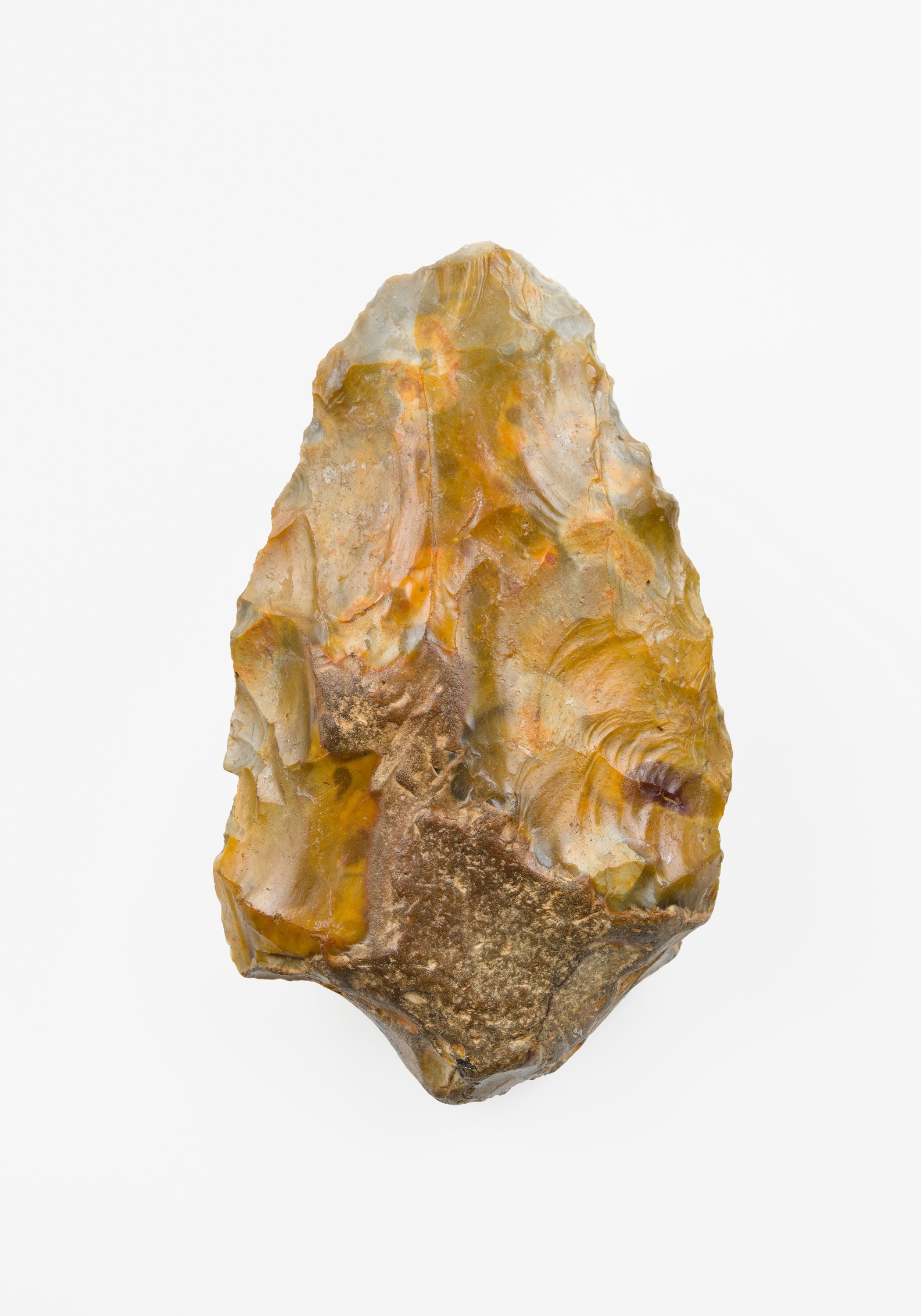 Acheulean Hand Axe, 700,000-650,000 BP
The Northern and Central European collection can be divided into three main sub-collections: A stone tool collection representative of the development of lithic technology in Northern Europe from 650,000BP into the Neolithic period; Neolithic to mid first millennium AD material culture, supplemented with replicas; and a Medieval to early modern European collection which was part the founding donation of Sir Charles Nicholson.
The stone tool collection began soon after the establishment of the University of Sydney’s Museum of Antiquities with a donation from the British Museum in 1862 of material from Jacques Boucher de Perthes excavations of the Valley of the River Somme at Abbeville, France. This included a series of Acheulean hand axes, the most significant of which is NMR.1178 dated to 700,00-650,000 BP. It is the only artefact in the collection not made by Homo Sapiens. In 1864, Sir Charles Nicholson donated a series of 50 stone tools he had collected in Denmark under the guidance of Conrad Engelhardt from an unidentified midden.
Further stone tools were acquired during the curatorial tenure of Arthur Dale Trendall (honorary curator 1939-58) who, working with James Stewart, actively pursued international collections with offers of exchange, including Indigenous Australian cultural material, to help build up the Nicholson’s holdings. Stone tools were received from Cambridge University, National Museum of Stockholm, National Museum of Helsinki, and the National Museum of Copenhagen. During the 1960s Vincent Megaw, lecturer in the Department of Archaeology, continued to build on the collection with stone tools received from a variety of Scandinavian, French and UK museums and universities. Today the Nicholson Collection includes over 800 European stone tools.
The Northern-Central European collection of material culture, which dates from the Neolithic period through to the middle of the first millennium AD, was developed during the 1960s under the guidance of Vincent Megaw and curatorship of Alexander Cambitoglou. During this decade, hundreds of artefacts were sourced representing the differing cultures and time periods of the region with ceramic sherds and small bone and bronze objects the primary materials acquired. The collection was supplemented with the purchase of replicas of significant objects such as the The Folkton Drums, held by the British Museum, and the Mšecké Žehrovice Head discovered in Prague. The efforts of Megaw and Cambitoglou to establish this collection were presented in the 1962 exhibition Foundations of Europe 6000BC-AD600.
Sir Charles Nicholson’s collection of antiquities included a range of Medieval and early modern European artefacts that were donated between 1858 and 1865 to the University of Sydney. Although this aspect of the Nicholson Collection was not subsequently developed, much of the founder’s collection remains as part of the Museum’s holdings today. Of particular interest is a framed set of human remains belonging to Jean sans Peur and his wife, a Flemish reliquary of the 16th century, Maiolica ware ceramics, bone and ivory crucifixes, 17th century English armour and a series of lead ‘Bill and Charley’ figurines.
Key publications:
- Turner, M. (2012). 50 Objects, 50 Stories. Extraordinary Curiosities from the Nicholson Museum, University of Sydney. Nicholson Museum.
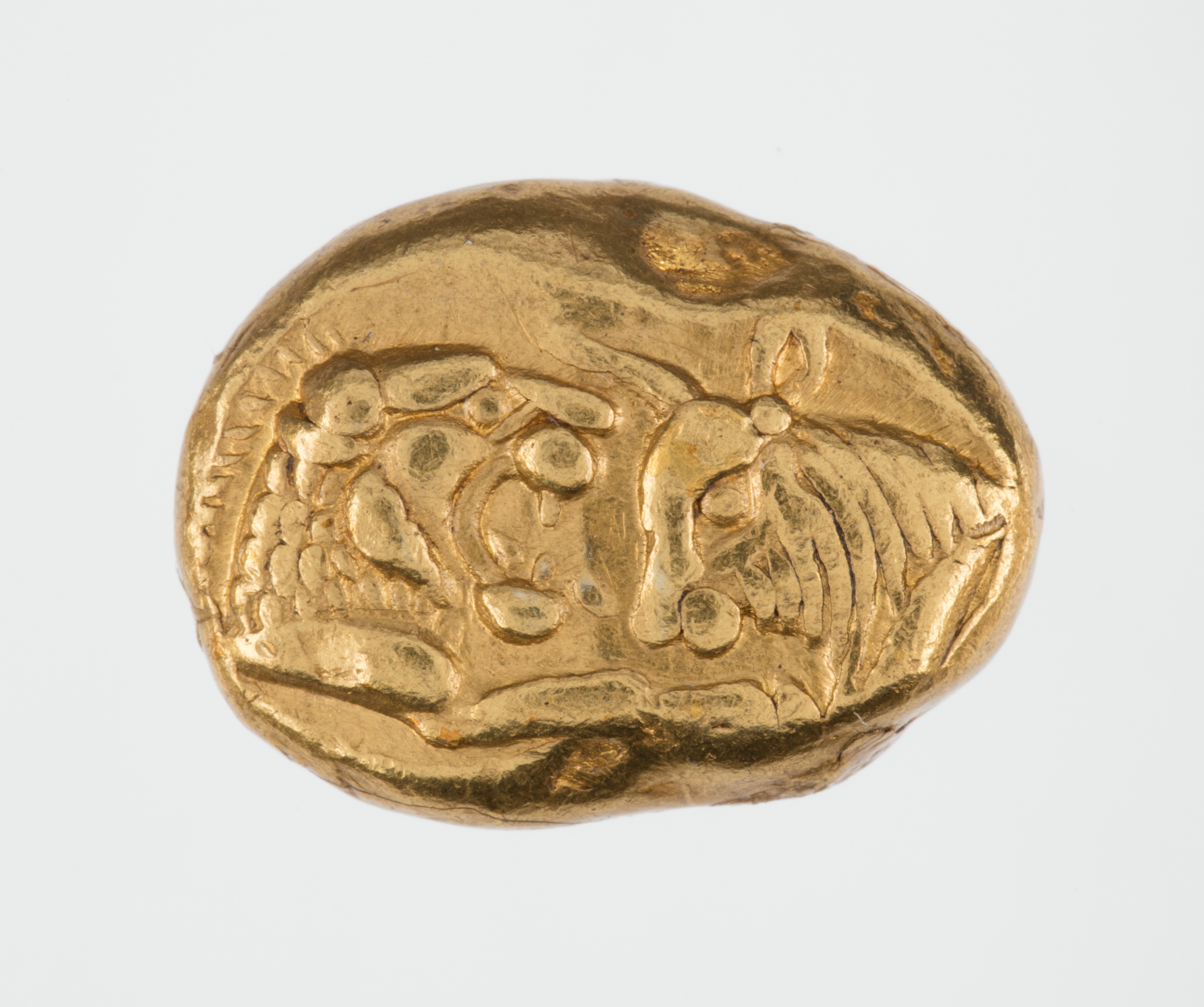
The Nicholson Collection includes a significant numismatics collection of roughly 9000 coins, paper notes, medals and electrotype replicas. The majority of the numismatic materials relate to the ancient Mediterranean and Middle East. However, private donations outside the Nicholson’s traditional collecting areas have contributed significant colonial Australian and American currencies and modern European items.
The earliest contributions to the numismatics collection were a variety of Roman coins by M.S. Marchange in 1863, Sir Charles Nicholson in 1865 and Sir John Young in 1867, published by Edward Reeve in 1870. In 1938 the Nicholson Collection received the significant numismatic collection of A.B. Triggs, comprising approximately 2500 gold, silver, electrum and bronze coins related to the monetary production of the Greek city states, Phoenicia, Asia Minor and Seleucid kingdoms as well as Roman mints from the West to Byzantine East.
Throughout the middle of the 20th century significant purchases of recently discovered coin hoards contributed greatly to the Nicholson’s numismatic holdings including:
- 121 coins dated to AD250-259, from the ‘Dorchester’ hoard, acquired in 1948;
- Over 3500 coins dated between AD 253-275 known as the ‘Clapton-in-Gordano’ hoard discovered in 1924 in Somerset England, and acquired in 1949;
- 204 coins from Mount Carmel, Palestine, buried shortly before AD 296, purchased in 1948;
- 463 coins from the Bawtry-Everton Notts, England, hoard, discovered 1881, purchased in 1948;
- 13 coins from the 5th century BC hoard discovered in 1947-48 at Tell el-Maskhouta, Egypt, known in antiquity as Pythom-Heroopolis, purchased 1949.
- 7 coins related to Celtic central Europe dated to 300-1 BC, from Le Câtillon Hoard discovered on the island of Jersey on 22 January 1957, purchased in 1962.
During this period the University also purchased a series of 800 electrotype replicas of ancient Greek coin types to supplement the collection for teaching purposes.
The numismatics collection has been the beneficiary of many individual donations of coins and small collections including a series of coins relating to late Roman and early Islamic Jordan from Crown Prince Hassan of Jordan, in 1977. In 1989 the Nicholson Collection received a significant collection of 178 Ptolemaic coins from the estate Jon Hosking, a frequent volunteer for the University of Sydney’s Pella Project and numismatics enthusiast.
Of interest from the colonial and European collections are a series of currencies related to historical economic crises, including: Australian ‘Hanks and Lloyd’ coin tokens, created in the 1850s in response to coin shortages in the colonies; colonial American paper money dated to 1770s and mid 1860s; a series of Austrian paper emergency money dated to 1920; and a 1776 French ‘Promesse de mandate territorial’ from the time of Napoleon’s invasion of Egypt.
The Chau Chak Wing Museum also holds further numismatic material, particularly medals and badges related to the University of Sydney, the history of New South Wales, and 19th to early 20th century Europe, under the umbrella of the Macleay Collections and University Heritage Collection.
Key publications:
- P. Brennan, M. Turner and N. Wright. 2007. Faces of Power: Imperial portraiture on Roman coins. Sydney: Nicholson Museum, The University of Sydney
- C. Pitchfork. 2000. The Jon Hosking Collection of Ptolemaic Coins. Sydney: Nicholson Museum, The University of Sydney
- 1924. Catalogue of a collection of Greek, Roman and English coins, in the possession of A.B. Triggs, Yass, New South Wales. London: Spink & Son
The Nicholson Museum
The Nicholson Museum permanently closed in February 2020.
The Nicholson Collection is now on display at the Chau Chak Wing Museum.
Featured image (top of the page): Cast mosaic glass bowl, 80BC-75AD.